

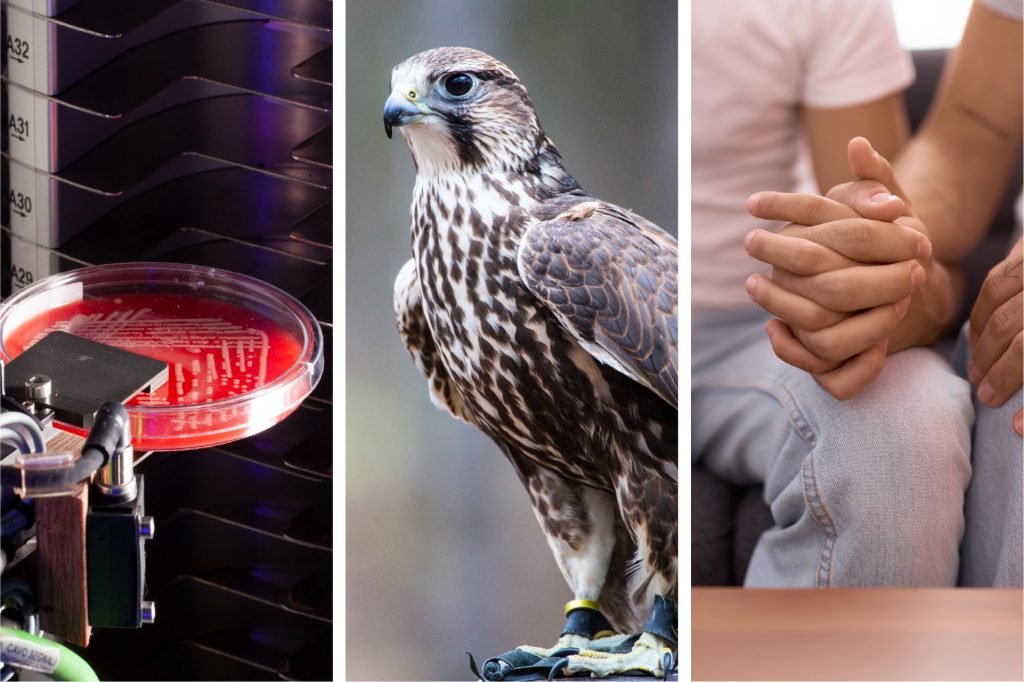
This month’s Microbiology Time features a Swiss case study on fully automating a clinical microbiology laboratory, a paper on AMR in raptors, and a multicenter study assessing the acceptability of self-collection for anal cancer screening in men.
Fully automating a clinical microbiology laboratory: a Swiss experience
Clinical microbiology laboratories face mounting pressure from rising specimen volumes, staffing shortages, and cost constraints. Total laboratory automation (TLA) addresses these pressures by integrating robotic specimen handling, smart incubators, and digital imaging into a continuous workflow, reducing reliance on manual plate reading and batch processing. This first paper of the month describes the experience at Geneva University Hospitals, where 97% of automatable specimen types now pass through a fully automated system. The operational gains are measurable: turnaround time for negative urine culture reports and MRSA screening has dropped consistently. AI-assisted plate reading with PhenoMATRIX® PLUS achieved 100% sensitivity and 95.2% specificity for MRSA detection. Fully automated disk diffusion now covers 98% of antimicrobial susceptibility panels. Deep-learning Gram stain interpretation achieved agreement above 95% with manual microscopy, though the authors note this has not displaced conventional workflows in all settings. Molecular diagnostics – PCR, targeted NGS, and metagenomic sequencing – are organized around a funnel model: automated phenotypic methods run first, with molecular assays reserved for selected or unresolved cases. Stool testing and tuberculosis diagnosis are deliberate exceptions, with molecular testing performed upfront. The authors argue that molecular diagnostic stewardship, not just more technology, determines whether these tools deliver clinical value.
Raptors as sentinels for antimicrobial resistance
Raptors occupy the interface among wildlife, agricultural environments, and human activity, making them useful sentinels for tracking the spread of antimicrobial resistance. This single-facility study from Western Romania collected fresh fecal samples from 40 captive Saker Falcons (Falco cherrug) and characterized the recovered Gram-negative bacteria through identification and susceptibility testing, followed by conventional PCR for genotypic confirmation. Escherichia coli was the dominant isolate (60%), with resistance detected primarily to ampicillin and tetracycline (both 20% of Enterobacteriaceae). Carbapenem efficacy remained high, with 90% imipenem susceptibility. PCR screening identified key resistance genes, including blaZ and ampC (62.5%), tetK (37.5%), and blaOXA-61 (37.5%). MDR profiles were confirmed in Hafnia alvei and Escherichia hermannii isolates. The authors are careful not to overinterpret these findings: no parallel sampling from humans, domestic animals, or environmental matrices was performed, so transmission routes cannot be inferred. The data serve as a regional baseline, and the authors call for broader surveillance integrating metagenomic approaches and mobile genetic element analysis across captive and wild raptor populations.
Acceptability of self-collection for anal cancer screening
Anal cancer incidence among gay, bisexual, and other men who have sex with men (GBMSM) living with HIV can reach rates comparable to those of cervical cancer before systematic screening programs existed. Despite this, uptake of anal screening remains low, driven by stigma, procedural discomfort, and logistical barriers. This multicenter study from Barcelona (aSELF-GEN) tested whether self-collected anorectal swabs matched clinician-collected samples for HPV genotyping across 28 HPV types and whether participants found the procedure acceptable. Self-sampling demonstrated strong diagnostic performance, with 96.0% overall agreement (κ = 0.75), 96.4% sensitivity, and 90.9% specificity versus the clinician-collected reference standard. HPV16 concordance was particularly high (κ = 0.88). Sample stability at 30°C over 15 days remained excellent (>98% agreement), supporting postal-based decentralized workflows. Participant acceptability was consistently high across all five feasibility domains – learnability, efficacy, satisfaction, suitability, and willingness – with 94% willing to repeat self-sampling and 74% open to mailing samples. There are limitations, including using clinician collection as the reference standard rather than histopathology, recruiting exclusively from STI/HIV clinics, and enrolling only one transgender woman. Nonetheless, the data make a reasonable case for incorporating anal HPV self-sampling into screening guidelines for GBMSM and transgender individuals, particularly those unlikely to attend clinic-based examinations.
Join CoScience Hub
Create your CoScience Hub account now to access cutting-edge science and position yourself at the forefront of innovation.
Sign Up Now


