

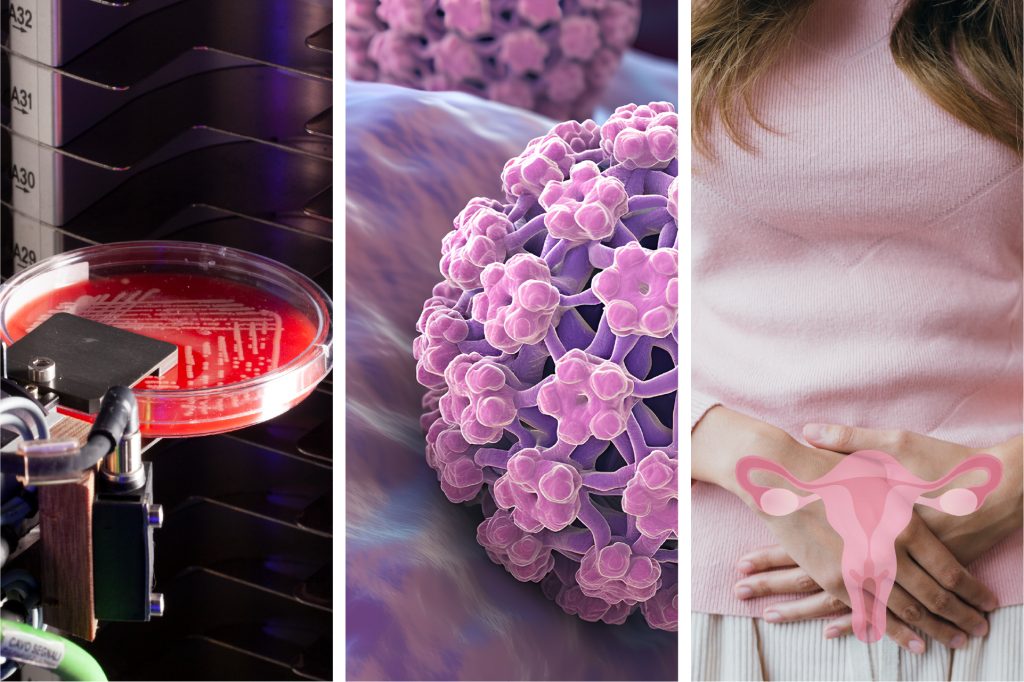
Improved diagnostic accuracy of osteoarticular infections through lab automation, an evaluation of storage and handling conditions for self-collected HPV testing samples, and an Australian study focused on expanding HPV screening eligibility: discover what we selected in February’s Microbiology Time.
Ease osteoarticular infections diagnosis with lab automation
The first study investigates the diagnostic challenges of osteoarticular infections (OAIs), especially when standard culture methods fail to identify the causative pathogen. The authors developed a sequential diagnostic workflow for intraoperative orthopedic tissue samples that combines lab automation, broth enrichment, and next-generation sequencing (NGS). The Italian team at Luigi Sacco Hospital in Milan examined 702 samples from 117 patients suspected of having OAIs. Lab automation detected pathogens in 42% of cases, while broth enrichment and NGS added another 23% and 11.5%, respectively, in cases where automation was negative. This workflow allowed clinicians to obtain diagnostic results within 10 days and improved detection rates, especially for culture-negative infections. The authors conclude that combining advanced microbiological tools is practical and valuable in managing suspected OAIs, but multidisciplinary interpretation of results remains crucial for patient care.
Assessing the quality of vaginal and urine samples for HPV testing
In the second study, the UK researchers evaluated whether different storage conditions and laboratory handling procedures influence the suitability of self-collected samples for HPV testing. Using a prospective matched design, 177 women referred for abnormal cytology or recurrent HPV infection provided first-void urine, two types of vaginal self-samples (dry and wet FLOQSwabs), and a clinician-collected cervical sample. All samples were tested either immediately or after one or two weeks of room-temperature storage. Results showed that dry vaginal self-samples maintained DNA quality comparable to wet samples when processed within two weeks, with no statistically significant differences in genomic DNA quality scores. Urine samples exhibited lower HPV positivity than vaginal and clinician-collected samples, indicating reduced sensitivity. The authors concluded that dry vaginal self-collection using a FLOQSwab is suitable for HPV testing when processed within two weeks at room temperature and may serve as a reliable alternative to clinician-collected samples.
Expanding screening eligibility to boost cervical cancer elimination
Lastly, a notable paper published in The Lancet. Sultana and colleagues studied the effects of expanding eligibility for self-collected HPV testing in Australia’s National Cervical Screening Program. Initially offered only to women aged 30+ who were overdue for screening or had never been screened, self-collection was later made available to all women aged 25–74. The team compared the detection rates of high-grade lesions and cervical cancer between self-collected and clinician-collected samples among those referred for colposcopy. After expanding eligibility, self-collection adoption increased sharply, especially among long-overdue women, women in remote or disadvantaged areas, and those aged 70–74. Throughout the entire study period, 9.8% of women had a valid HPV test; during the first year of universal eligibility, HPV positivity was slightly higher in self-collected samples than in clinician-collected ones. Despite baseline differences, the detection of high-grade lesions and cancer was similar across methods. The authors conclude that universal self-collection greatly boosts participation, especially among under-screened groups, while maintaining diagnostic accuracy, promoting equity, and supporting global efforts to eliminate cervical cancer.
Join CoScience HUB
Create your CoScience HUB account now to access cutting-edge science and position yourself at the forefront of innovation.
Sign Up Now


