

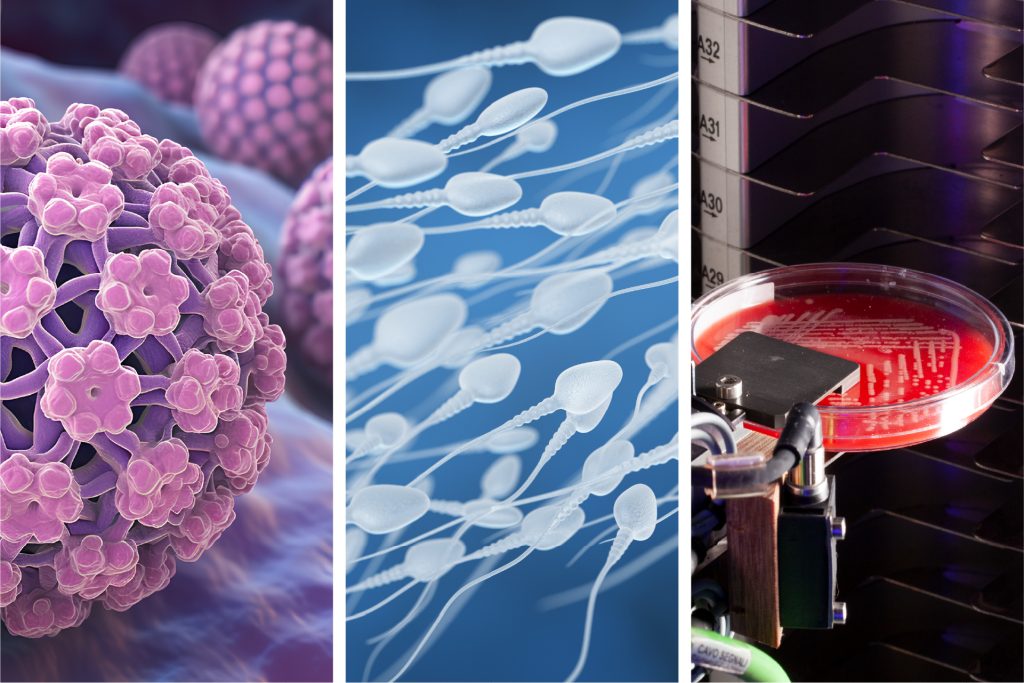
Featured in this month’s edition of the Microbiology Time are a comparison of collection devices for HPV screening in Denmark, a study analyzing the seminal microbiome after vasectomy, and the impact of full lab automation on urine culture workflow.
Women’s Preferences for HPV Self-Sampling in Denmark
In the largest head-to-head device comparison conducted to date within a routine cervical cancer screening program, 1,760 women in the Capital Region of Denmark evaluated three HPV self-sampling devices (the Evalyn brush, the Copan FLOQSwab, and the SensiGrip) in paired comparisons with a randomized sampling order. Overall, 95.7% rated self-sampling as a positive experience, and 87.3% expressed a preference for self-sampling at their next screening, confirming that acceptability of the modality is not the limiting factor in program uptake. SensiGrip was significantly preferred over FLOQSwabs, with moderate-to-large effect sizes for ease of use and sampling certainty – dimensions that directly bear on user confidence. Evalyn showed comparable overall acceptability to both alternatives in the primary implementation-focused analysis, though it scored highest on perceived sampling certainty across all comparisons. Sampling order influenced preference in Evalyn comparisons, underscoring the importance of randomization in device evaluation studies. Notably, prior self-sampling experience, screening history, subcohort membership, and age had no meaningful influence on device preference, suggesting that immediate device ergonomics drive acceptance. These data support the feasibility of transitioning to SensiGrip without compromising participation, while also raising cost and logistics considerations, given that swab-based devices carry substantially lower unit and shipping costs than brush-based alternatives.
Vasectomy and the Seminal Microbiome
Vasectomy induces modest but measurable shifts in seminal microbial composition without eliminating overall bacterial richness. In this Spanish study, a prospective cohort of 82 men collected paired semen and urine samples before and three months after the procedure, revealing that more than 60% of seminal bacterial genera were also detectable in urine. This is a substantially higher overlap than previously reported, likely reflecting shared urethral transit pathways and biofilm persistence. Beta-diversity changed significantly after vasectomy, though inter-individual variation accounted for most of the observed variance. No specific taxa survived FDR correction after multiple-testing adjustment. Functional pathway analysis predicted a post-vasectomy reduction in lipid metabolism, a finding with potential relevance given established links between fatty acid dysregulation and impaired semen quality. The study employed rigorous decontamination controls and Copan’s eNAT® transport medium to stabilize urine. These findings provide a mechanistic context for understanding how genitourinary compartment connectivity shapes the seminal microenvironment.
Impact of Total Laboratory Automation on Urine Culture Turnaround Time
In one of the largest real-world evaluations of total laboratory automation in clinical microbiology to date, implementing the Copan WASPLab™ system at a high-volume reference laboratory in Riyadh reduced the median urine culture turnaround time by approximately 18 hours across both result categories. Median TAT for negative and positive cultures decreased, with the most pronounced gains in negative specimens, which represent roughly 80% of routine urine culture volume, reflecting automation’s ability to replace batch-based manual reading with continuous incubation and scheduled digital imaging. Beyond speed, reporting variability narrowed substantially, an operationally significant finding given that inconsistent TAT undermines clinician confidence and complicates antimicrobial stewardship decisions. Productivity gains were striking, suggesting that efficiency improvements were attributable to automation rather than staffing expansion. For laboratory directors and antimicrobial stewardship teams, these data provide quantitative support for TLA investment in high-throughput microbiology settings.
Join CoScience Hub
Create your CoScience Hub account now to access cutting-edge science and position yourself at the forefront of innovation.
Sign Up Now


