

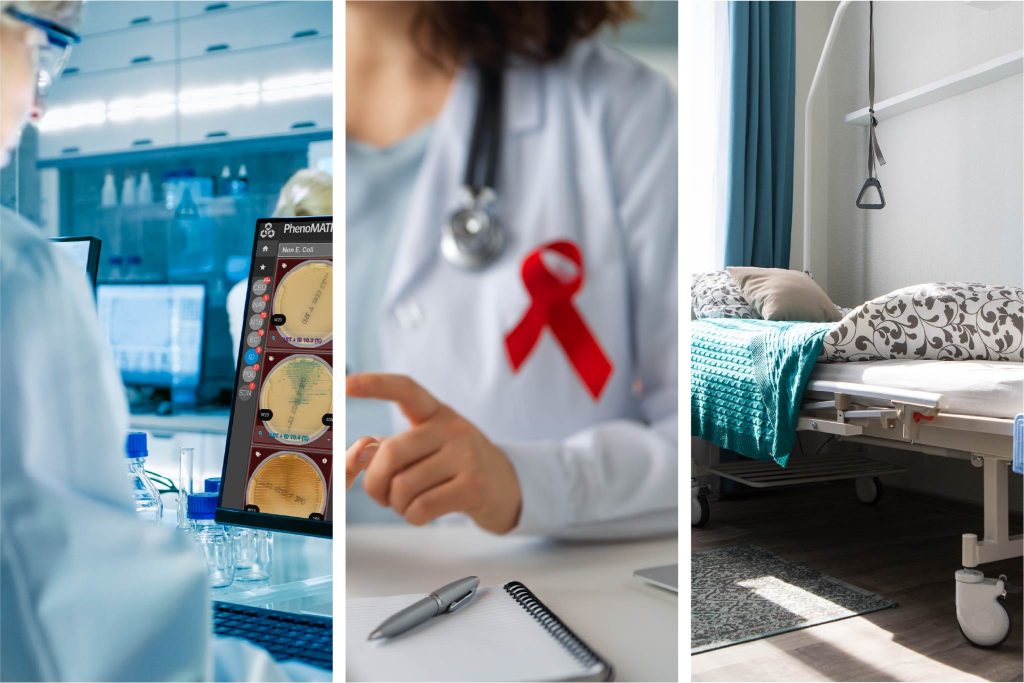
AI applications for Multi-Drug Resistant Organisms, saliva-mediated HIV screening, and rapid nosocomial surface monitoring are the three topics featured in July’s Microbiology Time.
Artificial Intelligence supports rectal MDROs screening
The first study, conducted by Professor Schrenzel’s group, evaluates the performance of PhenoMATRIX® PLUS in an institution-wide, culture-based rectal screening for multidrug-resistant organisms (MDROs).
After a machine learning phase involving thousands of previously classified agar plates, more than 20,000 plate images from 4,517 unique specimens were analyzed.
The system showed high agreement with manual readings for No Growth and Negative results, although the classification Send to Reader had slightly lower agreement.
Additionally, the software significantly reduced laboratory workload, allowing technologists to focus on confirmatory testing of presumptive positives and improving both staff efficiency and resource management.
HIV screening and saliva collection in Ghana
We moved to Ghana for the second study, where E. Aninagyei and colleagues evaluated the detection of HIV-1 antibodies in saliva using the Self-LolliSponge and a blood-based rapid test.
The sensitivity and specificity of saliva-based HIV-1 antibody detection were 72.9% and 100%, respectively.
Several factors, such as opportunistic infections, fatigue, and fever, significantly increased the likelihood of antibody detection: over 90% of people living with HIV who had combinations of these factors tested positive.
HIV-1 antibodies remained detectable in all saliva samples throughout 60 days of storage at 6°C.
Overall, the researchers describe Self-LolliSponge as user-friendly, cost-effective, and capable of preserving HIV antibodies for extended periods, supporting saliva as a viable alternative to blood for HIV diagnosis.
Speed up surface contamination testing with LAMP
Bologna, Italy: Professor Cristino’s team compared loop-mediated isothermal amplification (LAMP) to the gold-standard cultural method for detecting nosocomial pathogens – P. aeruginosa, S. aureus, E. faecalis – on contaminated surfaces.
Sterile surfaces were inoculated with varying concentrations of different pathogens and analyzed using either agar contact plate culture or LAMP after three, six, or nine hours of pre-incubation.
Overall, LAMP demonstrated strong performance, especially after six to nine hours of pre-incubation, suggesting it could serve as a reliable and rapid strategy for surface monitoring in healthcare environments – although additional real-world validation remains necessary.
Join CoScience HUB
Create your CoScience HUB account now to access cutting-edge science and position yourself at the forefront of innovation.
Sign Up Now


