

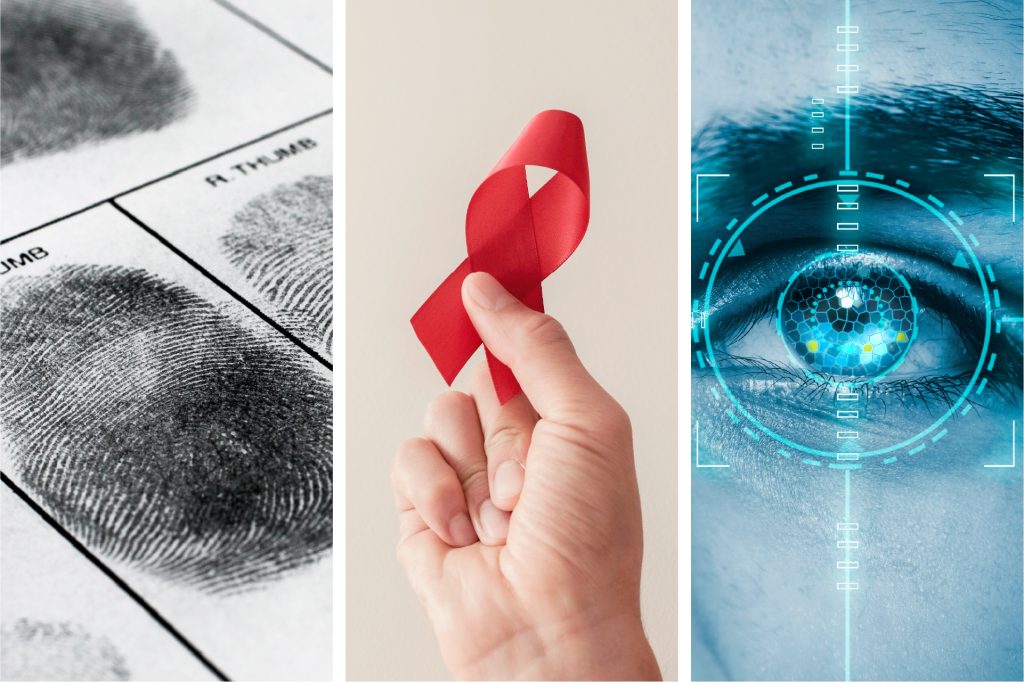
From preserving crime scene DNA to decoding HIV’s impact on the oral microbiome and refining forensic phenotyping for Italian populations: these are the groundbreaking discoveries included in this issue.
Preserve precious biological material with subsampling
The first paper by Defontaine et al. evaluated a swab subsampling method for the updated RapidHIT™ ID V2 rapid DNA system, aiming to preserve primary biological material for downstream testing while generating interpretable STR profiles. Building on a previously tested protocol, the authors examined two subsampling devices – a subungual mini-swab and microFLOQ® – across blood and buccal reference swabs. The researchers confirmed that subungual mini-swab subsampling remains effective on the RapidHIT™ ID V2, producing usable STR profiles from blood under GENERAL and SPECIALIZED protocols. microFLOQ® showed no inhibition in blood applications but failed to yield suitable profiles from buccal swabs, precluding a recommendation based on current evidence.
The connection between HIV and oral microbiome
Muhammad Anshory and colleagues authored the second article, where they investigated the composition of the oral microbiome in people living with HIV in Indonesia. They examined associations with antiretroviral therapy (ART) status, age, and sex. Using 16S rRNA gene sequencing of oral rinse samples from 245 adults – including ART-treated, ART-naïve, and HIV-negative individuals – the authors characterized microbial diversity and differential abundance across groups. HIV-positive individuals show a distinct oral dysbiosis compared to controls, with ART-naïve participants exhibiting the highest alpha diversity and enrichment of pro-inflammatory genera. ART-treated individuals display partial recovery toward control microbiome profiles, though persistent depletion of commensal taxa persists. On top of HIV status, also age and sex independently contribute to microbial variation. The authors suggest that combining microbiome profiling with demographic factors could help inform personalized oral health interventions for HIV-positive populations.
Italian traits in the European DNA phenotyping project
The third paper examined the allele frequency distribution of 24 SNPs in a large Italian cohort with at least three generations of verified ancestry, contributing to the broader European dataset for Forensic DNA Phenotyping (FDP). Genotypic data were analyzed using the SNaPshot sequencing technique and uploaded to the VISAGE Consortium-validated FDP web tool, which generates prediction probabilities for three eye color and four hair color categories. Results confirm high predictive accuracy for the Italian population, consistent with existing European models. However, the authors highlight ongoing challenges in predicting intermediate phenotypic traits, attributing these to the complex underlying genetic architecture. The observed north–south European gradient in eye color, potentially linked to skin pigmentation and UV adaptation, is discussed as motivation for incorporating additional genetic markers. The authors advocate for including Italian population data in refined European predictive models to improve FDP accuracy for complex pigmentation phenotypes.
Join CoScience HUB
Create your CoScience HUB account now to access cutting-edge science and position yourself at the forefront of innovation.
Sign Up Now


