

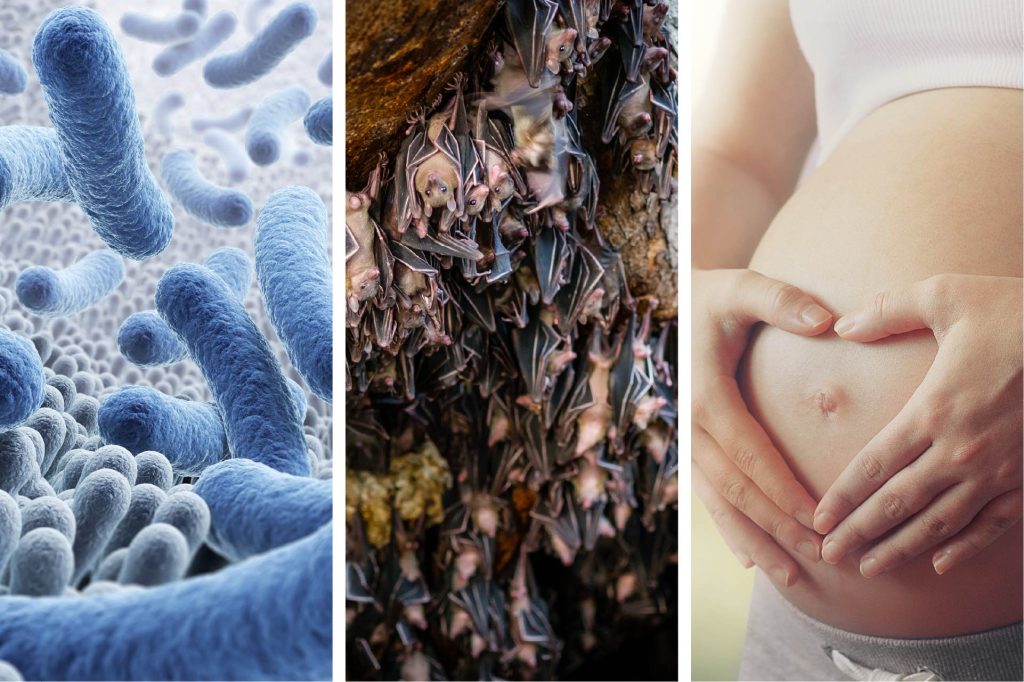
The three papers chosen for this month’s microbiology review cover Lactobacillus crispatus and the vaginal microbiome, bat viruses in the Gobi Desert, and the use of self-collection for HPV-based cervical screening during pregnancy.
Toward a synthetic vaginal microbiome model
The human vagina hosts a unique vaginal microbiome that, in healthy individuals, is usually dominated by Lactobacillus species. However, the mechanisms behind the dominance of lactobacilli in this environment are still not well understood. To address this gap, Belgian researchers used synthetic microbial communities and metagenomic sequencing to study the stability and dynamics of Lactobacillus-dominated microbiome communities from healthy individuals. They successfully created reproducible communities containing Lactobacillus crispatus co-existing with Limosilactobacillus species and Lactobacillus jensenii. Genome-scale metabolic modeling further suggested that cross-feeding interactions might explain the stability of these microbial groups within a synthetic vaginal microbiome model. Overall, this work provides a reproducible method for building synthetic vaginal Lactobacillus communities and offers important insights to guide the development of future microbiome-targeted therapies.
The connection between bat viruses and zoonosis
In May 2022, a joint Italian-Mongolian expedition was conducted in the Gobi Desert to investigate bat viruses, as bats are recognized as natural reservoirs of emerging zoonotic viruses. Bats were captured across six oases and subsequently identified through both morphological and molecular methods. Fecal samples were collected and screened using a molecular protocol targeting viral agents of significance to human and animal health. A total of 74 bats were sampled, with the genus Plecotus being the most prevalent, followed by Hypsugo, Vespertilio, and Myotis. Viral nucleic acids were detected in a subset of samples, including coronavirus, mammalian orthoreovirus, and herpesvirus. These findings enhance current knowledge of viral circulation in bat populations, contributing to the elucidation of their role in the ecology and evolution of emerging zoonotic pathogens. The results underscore the importance of sustained viral surveillance in biodiverse and geographically isolated areas to identify potential threats to public and animal health and to strengthen global preparedness for future viral emergence.
HPV screening through self-collection in pregnant women
The third study selected this month’s microbiology review assessed the feasibility, safety, and acceptability of HPV self-sampling using self-collected vaginal samples among pregnant women attending an urban teaching hospital in Malaysia. The participation rate of eligible pregnant women invited was 71.1%. Among these, 99.6% agreed to perform self-collection, and 98.6% successfully completed the procedure. Over 80% of participants reported positive responses across key acceptability indicators (overall comfort, ease of use, convenience, and confidence in their ability to collect an adequate sample). No serious adverse events related to self-sampling were documented, and 99.0% of participants indicated willingness to use self-collection for future cervical cancer screening. These findings demonstrate that HPV screening in pregnancy through self-collection is highly acceptable, safe, and feasible, with performance comparable to that observed in non-pregnant populations. Integrating self-collection into routine antenatal care may improve cervical cancer screening coverage, particularly among under-screened groups, and support progress toward global cervical cancer elimination targets.
Join CoScience HUB
Create your CoScience HUB account now to access cutting-edge science and position yourself at the forefront of innovation.
Sign Up Now


